
DEFINITION OF A MASJID
The word Masjid (Masjid) literally means a place for prostration. In terms of terminology, it refers to a place of worship for Muslims, specifically for the performance of ritual prayers (shalah). A Masjid is often called Baitullah (the House of Allah)—a structure established as a means to serve Allah. During the Hijrah (migration) from Mecca to Medina, accompanied by his companion Abu Bakar, the Messenger of Allah (Rasulullah—peace and blessings be upon him) passed through the area of Quba. There, he established the first Masjid of his prophetic era: the Masjid Quba (Quran 9:108, Surah At-Tawbah). Upon arriving in Medina, the Messenger of Allah also established a Masjid—a place for Muslims to perform congregational prayers and engage in other social activities. Over time, this became known as the Masjid Nabawi (the Prophet’s Masjid).
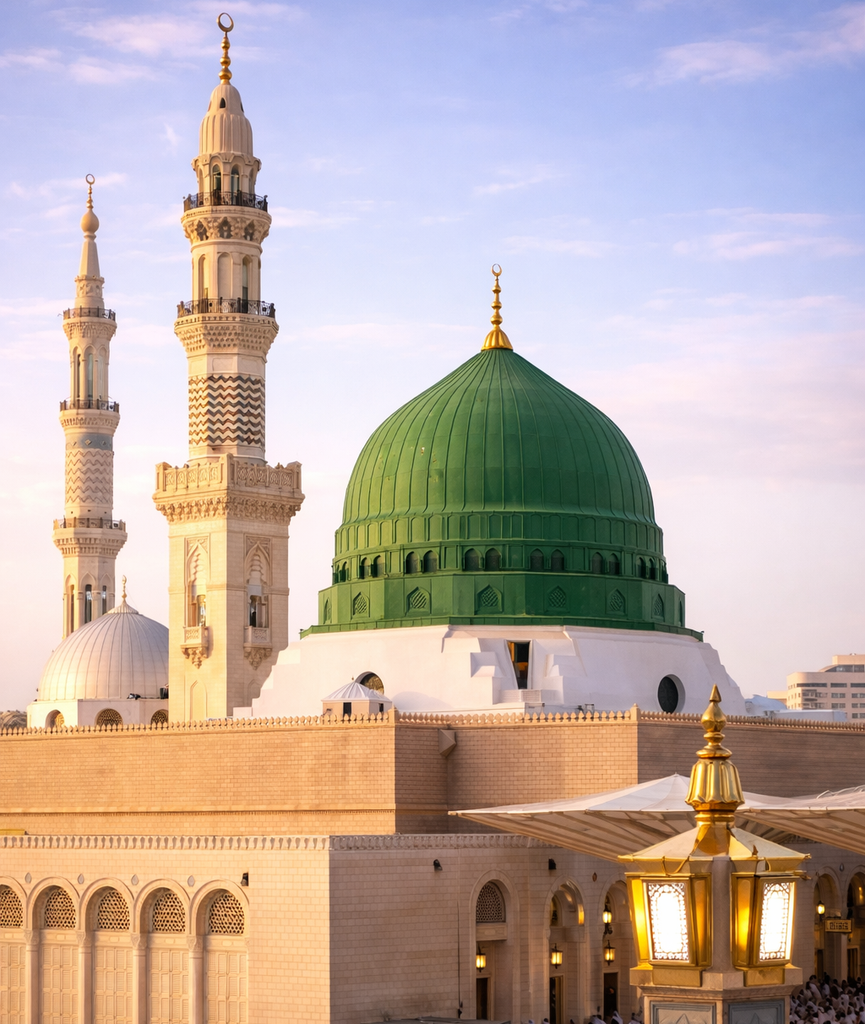
The main function of a Masjid is as a place to carry out congregational prayers. If we pay attention, congregational prayer is one of the basic teachings of Islam, the sunnah of the Prophet in the muhaditsin sense, not fuqaha, which means the actions that he always carried out. The teachings of the Prophet sallallaahu ‘alaihi wa sallam regarding congregational prayer are commands that are truly emphasized to Muslims.
Abdullah Ibn Mas’ud r.a. said: “I saw all of us (the companions) attending the congregation. No one was left out of attending the congregation, apart from the munafiq whose hypocrisy had been revealed, and indeed now they were being brought to the Masjid held by the arms of two people, one on the right, one on the left, so that they were placed in the row.” (HH: Al Jamaa’ah, apart from Bukhory and Turmudzy).
Ibn Umar r.a. said: “The Messenger of Allah said: “Congregational prayer exceeds individual prayer by twenty-seven degrees.” (HH: Bukhory and Muslim).
In essence, the core of enlivening the Masjid lies in establishing congregational prayer, which is one of the greatest symbols of Islam; other activities are merely extensions of this. Congregational prayer serves as the primary indicator of our success in enlivening the Masjid. Thus, our success—or lack thereof—in this endeavor can be measured by the level of enthusiasm among Muslims for establishing congregational prayer.
Although its primary function is as a place to perform prayers, the Masjid is not merely a venue for prayer. During the time of the Messenger of Allah (peace and blessings be upon him), in addition to being used for prayer, dhikr (remembrance of Allah), and i’tikaf (spiritual retreat), the Masjid served social purposes. For instance, it was a place for learning and teaching virtue (seeking knowledge), caring for the sick, resolving li’an cases (legal proceedings regarding allegations of marital infidelity), and so forth.
Throughout its history, the Masjid has undergone rapid development in terms of both its architectural form and its functions and roles. It can be said that wherever there is a Muslim community, there is a Masjid; indeed, the Muslim community is inseparable from the Masjid. Beyond serving as a place of worship, the Masjid has become a venue for gathering, acquiring knowledge, exchanging experiences, and acting as a center for da’wah (religious outreach), among other activities.
Muslims establish many Masjids—whether for the general public, schools, offices, university campuses, or other settings. These Masjids are built to fulfill the community’s needs—particularly spiritual ones—enabling people to draw closer to their Creator and to submit in humble obedience to Allah Subhanahu wa Ta’ala. The Masjid serves as a spiritual anchor, a sanctuary amidst life’s journey, and a source of vitality for the community. Moreover, establishing a Masjid brings immense reward in the sight of Allah.
Uthman ibn ‘Affan (may Allah be pleased with him) narrated that the Messenger (peace and blessings be upon him) said: “Whoever builds a Masjid for the sake of Allah, Allah will build for him a similar structure in Paradise.” (Reported by Al-Bukhari and Muslim).
SOME FUNCTIONS AND ROLES OF THE MASJID
The Masjid plays a dominant role and serves significant functions in the lives of Muslims; some of these include:
- As a place of worship. True to its name—Masjid (a place of prostration)—its primary function is as a venue for performing the ritual prayer (shalat). Given that the concept of worship in Islam is broad, encompassing all life activities aimed at seeking Allah’s pleasure, the Masjid serves not only as a place for prayer but also as a center for worship in the wider sense, in accordance with Islamic teachings.
- As a place for acquiring knowledge. The Masjid functions as a center for teaching and learning, particularly regarding religious knowledge, which is an individual obligation (fardlu ‘ain) for Muslims. Furthermore, other disciplines—such as the natural sciences, social sciences, humanities, vocational skills, and more—can also be taught within the Masjid.
- As a center for community development. With a Muslim community in the surrounding area, the Masjid plays a role in coordinating them to unite the community’s potential and leadership. Through organized structures such as the Masjid Management Board (Ta’mir Masjid), the community is nurtured in terms of faith (iman), piety (taqwa), faith-based brotherhood (ukhuwah imaniyah), and Islamic outreach (da’wah). Consequently, the Masjid becomes a solid foundation for the Muslim community.
- As a center for da’wah (Islamic outreach) and Islamic culture. The Masjid is the pulsating heart of the Muslim community, constantly active in disseminating Islamic da’wah and culture. It is within the Masjid that Islamic da’wah and cultural initiatives—designed to meet the community’s needs—are planned, organized, studied, implemented, and developed. Thus, the Masjid serves as a hub for da’wah and cultural activities.
- As a center for community leadership development. As a venue for nurturing the congregation and fostering leadership, the Masjid requires activists dedicated to upholding Islam with steadfastness and continuity—ensuring that as one generation passes, another rises to take its place. Consequently, the development of future leaders must be prepared and centered at the Masjid, spanning from childhood through adulthood. This is facilitated through initiatives such as Quran Education Centers (QEC), Masjid youth groups, and Masjid management committees (Ta’mir) along with their respective activities.
- As a foundation for the resurgence of the Muslim community. The Muslim community has designated this 15th Hijri century as the century of Islamic resurgence. Having long slumbered and lagged behind in the arena of global civilization, Muslims are striving to rise again, grounded in their religious values. Islam is being studied and examined from various perspectives—including ideology, law, economics, politics, culture, and social affairs—followed by efforts to apply and develop these insights within the community’s actual life. The aim is to infuse worldly life with Islamic values and to wisely advance the process of Islamization across all aspects of existence.
The Muslim community is striving for this resurgence, a movement that requires the Masjid to serve as the base of the struggle. The Islamic resurgence begins at the Masjid and extends outward to the wider society. Therefore, actualizing the functions and roles of the Masjid in this 15th Hijri century is a matter of urgent necessity for the Muslim community. Back to basics; back to the Masjid.
ACTUALIZING THE FUNCTIONS AND ROLES OF THE MASJID
In general, the management of our Masjids remains a cause for concern. What solutions might be proposed to actualize the functions and roles of the Masjid in the modern era? This is a matter we should consider collectively so that the Masjid can once again become a hub of activity for the Muslim community, mirroring the example set by the Messenger of Allah (peace and blessings be upon him) and his companions.
We must first empower the Masjid before we can optimize its functions and roles. For this empowerment, we can employ the “Continuous Consolidation and Improvement for Masjid” (CCIM) method.
CCIM is a Masjid empowerment method that involves reorganizing the Masjid management body (Ta’mir Masjid) by leveraging all available potential, followed by continuous improvement. This method allows us to utilize established management and quality control techniques, such as the PDCA cycle, QC Tools, SAMIE, MMT, ISO 9000, the 5S methodology, and others.
Strengthening—or what is commonly referred to in organizational terms as “consolidation”—entails the systematic and purposeful organization of existing resources. The necessary actions include:
- Consolidating the understanding of Islam.
- Consolidating the organizational structure.
- Consolidating programs.
- Consolidating the congregation.
Improvements are essential to enhance performance in serving the congregation. Various effective improvement strategies can be selected and tailored to specific needs, ensuring that these efforts are carried out through a process of continuous improvement.
Alongside consolidation and improvement efforts, activities aimed at enlivening the Masjid and serving its congregation are conducted in accordance with the previously outlined functions and roles. These activities are structured through periodic work program planning and are translated into an annual Work Plan and Management Budget (WPMB).
The established plan is subsequently followed up by coordinating all available resources and executing the plan in a professional manner. The activities carried out are reported, evaluated, standardized, and reviewed to enhance both their quality and quantity.
In the present day, there is an increasing need to fully utilize Masjids, expand the reach of their activities and services, and manage them through sound organization and administration. In short, it is necessary to actualize the function and role of the Masjid by infusing it with a modern character and spirit. A workshop on Masjid management (idarah masjid), held in Jakarta by KODI DKI on November 9–10, 1974, defined the term “Masjid” as follows: “A Masjid is a place for worshiping Allah alone and serves as a center for Islamic culture.” This understanding implies that a Masjid must be free from shirk (polytheism) and purged of any activities that lean toward shirk. Furthermore, social activities—provided they are inspired by and consistent with Islamic teachings—may also be conducted within the Masjid.
“And indeed the Masjids belong to Allah. So do not worship anyone in them besides (worshiping) Allah.” (QS 72:18, Al Jin).
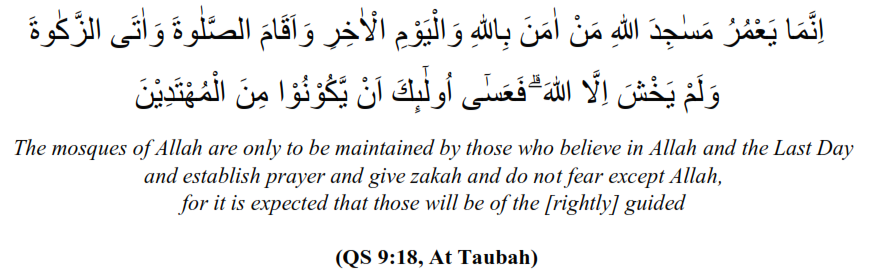
“Only those who prosper the Masjids of Allah are those who believe in Allah and the Last Day, and continue to perform prayers, pay zakat and do not fear (anyone) except Allah, then they are the people who are expected to be included in the group of those who are guided.” (QS 9:18, At Taubah).
The concept of the Masjid as both a place of worship and a center of Islamic culture has shaped the experience of modern Muslims in a unique way. It is not surprising that, God willing (insyaallah), we may encounter Masjids that are well-managed—maintained for cleanliness, hygiene, and aesthetic beauty—and organized through effective administration. Such Masjids often feature social service facilities, including clinics, Quran education centers, schools, madrasah diniyah (religious schools), study circles (majelis ta’lim), and more.
________________________
BIBLIOGRAPHY
Amidan and Usep Fathudin: “Guidelines for Masjid Development” (*Pedoman Pembinaan Masjid*), Directorate General of Islamic Community Guidance and Hajj Affairs – Ministry of Religious Affairs, Jakarta, 1980.
Dr. Yusuf Al-Qaradawi: “Guide to Building a Masjid” (*Tuntunan Membangun Masjid*), First Edition, Gema Insani Press, Jakarta, 2000.
Drs. Sidi Gazalba: “The Masjid as a Center of Worship and Culture” (*Masjid Sebagai Pusat Ibadah dan Kebudayaan*), 1st Edition, Bulan Bintang, Jakarta, 1989.
Drs. Ahmad Yani: “Guide to Revitalizing the Masjid” (*Panduan Memakmurkan Masjid*), DEA Press-Khairu Ummah, Jakarta, 1998.
Drs. Moh. E. Ayub, et al.: “Masjid Management” (*Manajemen Masjid*), Fourth Edition, Gema Insani Press, Jakarta, 2001.
Endang Saefuddin Anshari, MA: “Islamic Perspectives (Key Thoughts on Islam and the Muslim Community)” (*Wawasan Islam: Pokok-Pokok Pikiran Tentang Islam dan Umatnya*), 2nd Edition, CV Rajawali, Jakarta, 1991.
Ir. Siswanto: “Guide to Managing Masjid Congregation Associations” (*Panduan Pengelolaan Himpunan Jama’ah Masjid*), Pustaka Amani, Jakarta, 2002.
Ir. Siswanto: “Practical Guide to Masjid Youth Organizations” (*Panduan Praktis Organisasi Remaja Masjid*), Pustaka Al-Kautsar, Jakarta, 2005.
KODI DKI Jakarta: “Masjid Administration (Masjid Management)” (*Idarah Masjid/Manajemen Masjid*), 3rd Edition, KODI DKI Jakarta, Jakarta, 1982.