
Islam is a divinely revealed religion that teaches servitude to Allah—not only on an individual level but also collectively. This servitude encompasses both hablumminallah (one’s relationship with Allah) and hablumminannas (one’s relationship with fellow human beings), thereby fostering individuals who possess an integrated sense of both personal and social righteousness. Regarding social righteousness, Islam advocates for human life to be structured within an Islamic societal system—a social framework established and managed according to the values of Islamic Sharia.
APPLICATION OF ISLAMIC SHARIA
It needs to be understood that Islamic law does not only contain laws relating to crime, as there has been a misunderstanding -or deliberately misunderstood- by orientalists and their irresponsible followers. Islamic Sharia regulates all patterns of human behavior in all aspects of life, including aqidah, worship, shari’ah (in a special sense), muamalah and siyasah. Islamic Sharia is a blessing for all nature (rahmatan lil ‘alamin). For this reason, it must be implemented, so that this grace can be enjoyed by all mankind and the natural surroundings.
Correct application of Islamic law will give birth to an Islamic society with its own unique system. According to Sayyid Qutb, the main reason that led to the separation of the Islamic Society with its unique system was the fact that it was actually a society created by a unique Shari’a, created by Allah Himself. This Shari’ah has grown perfectly since it was created, without going through a process of historical evolution. This Shari’ah is what created Islamic society, built on the foundations that Allah willed for His servants, not according to concepts determined by the will of one group of humans towards the rest of humanity. And under the auspices of this Shari’ah, the growth of the congregation with an Islamic pattern is complete.
Along with this, there emerged relationships of labor and production, laws and moral norms governing individuals and society, fundamental principles of conduct, and rules for social interaction—encompassing, in fact, all the deliberate efforts to solidify the social order and chart a path for growth and development.
Islam is a way of life presented to humanity. A person’s adherence to Islam is not sufficiently defined merely by the recitation of the shahadah (testimony of faith), or even by the broader framework known as the Pillars of Islam. Islam must be embraced kaffah—in its totality (Quran 2:208, Al-Baqarah)—which includes the implementation of its sharia (divine law). One cannot accept certain Islamic teachings while rejecting others simply because they do not align with one’s own personal desires.
THE BENEFITS OF IMPLEMENTING ISLAMIC SHARIA
Striving to implement Islamic Sharia is an obligation for every Muslim. Both individually and collectively, the entire Muslim community bears the responsibility for upholding Islamic values within the state, society, the family unit, and within each person’s own life. This is because the values contained within Islamic Sharia—derived from the Quran and the Sunnah—must be implemented in daily life as evidence of the faith one has professed.
The implementation of Islamic Sharia constitutes an act of worship to Allah Subhanahu wa Ta’ala and serves as a robust bulwark for safeguarding Islam and its followers. The objectives and benefits gained from implementing Islamic Sharia include the following:
1. Preserving the existence of the Islamic religion.
2. Providing legal certainty and guarantees.
3. Protecting the security of property and life.
4. Safeguarding physical and spiritual well-being.
5. Minimizing the occurrence of crime and moral decay within society.
6. Supporting the realization of a civilized and prosperous society.
7. Fostering individuals and a society oriented toward taqwa (piety/God-consciousness).
8. Strengthening efforts toward national defense and security.
9. Insya Allah, guiding the Muslim community toward salvation in this world and the Hereafter.
Regarding the implementation of Islamic Sharia, Prof. Hasbi Ash Shiddieqy argues that it is universal—transcending specific localities or regions—and intended for all of humanity. It is a global system of law addressed to both Muslims and non-Muslims, as well as to those living within Islamic states and those outside of them. However, in practical terms, the application of Islamic Sharia is conditional; it can only be implemented in territories where the population is predominantly Muslim or which are under the governance of Muslims. Conversely, as the reach of Muslim governance diminishes, the scope within which Islamic Sharia can be applied also narrows.
In the modern era, Islamic Sharia can be implemented in both Islamic and non-Islamic states. Countries with a Muslim-majority population should, ideally, implement Islamic Sharia in its entirety. Meanwhile, Muslims who constitute a minority within a nation should strive, to the best of their ability, to uphold Islamic Sharia as broadly as possible. The implementation of Islamic Sharia is not limited solely to nations that formally declare themselves as Islamic States.
PLURALITY WITHIN ISLAMIC SOCIETY
From its inception, Islam dismantled racial barriers, returning humanity to a single origin and establishing that no race possesses inherent superiority over another. Differences in skin color, nationality, or language do not signify any special status or advantage. Instead, the intended ideal is for people to engage with one another positively, rather than seeking out differences or fostering hostility.
There is only one criterion for attaining an elevated standing: taqwa (piety/God-consciousness) toward Allah (Quran 49:13, Al-Hujurat)—manifested through obedience to Him and kind treatment toward His creation. This standard applies to everyone, irrespective of their ethnicity, language, nationality, or skin color. Consequently, the concept of racial discrimination was eradicated within Islamic society from the very beginning. Islamic society opens its doors to all of humanity, grounded in the principles of equality and justice—transcending distinctions of ethnicity, skin color, language, nationality, or even religion. In this way, Islamic society is capable of embracing the diversity of its members in all its pluralistic forms.
In the context of global development, pluralism is an unavoidable reality—a diversity that Islamic society is well-equipped to accommodate. However, this does not necessitate the adoption of secularism—the separation of state and religion—as practiced in Western societies and by those who follow their model. This holds true even when such separation is proposed to prevent the dominance of one religion over another or to promote religious tolerance. Islam does not recognize a division between religion and the state, as every aspect of human life is integrated within the framework of Islamic principles.
The liberal idea that champions absolute, boundless freedom of expression—invoking human rights in a manner that often feels forced—is likewise unacceptable. In an Islamic society, freedom of expression is granted a place commensurate with its proper scope, as the human rights of individuals within a social system are interconnected. Consequently, freedom that is proportional, responsible, and does not violate Islamic Sharia certainly has its place within an Islamic society.
Similarly, the concept of pluralism—which posits that all religions are equally valid—is also unacceptable within an Islamic society. Islam maintains a clear claim to truth. From an Islamic perspective, only Islam is the true religion; seeking any religion other than Islam will ultimately prove futile.
اِنَّ الدِّيْنَ عِنْدَ اللّٰهِ الْاِسْلَامُ
“Indeed, the [only] religion in the sight of Allah is Islam.” (Quran 3:19, Ali ‘Imran).
وَمَنْ يَّبْتَغِ غَيْرَ الْاِسْلَامِ دِيْنًا فَلَنْ يُّقْبَلَ مِنْهُ ۚ وَهُوَ فِى الْاٰخِرَةِ مِنَ الْخٰسِرِيْنَ
“And whoever seeks a religion other than Islam, it will never be accepted from him, and in the Hereafter, he will be among the losers.” (Quran 3:85, Ali ‘Imran).
However, Islam does not force everyone to become Muslim. Every member of the Islamic community is given the freedom to embrace their own beliefs, and express these beliefs openly while maintaining mutual tolerance.
“There is no compulsion to (enter) religion (Islam); indeed the right path is clearer than the wrong path. Therefore, whoever disbelieves in Taghut and believes in Allah, then indeed he has held on to a very strong rope that will never break. And Allah is All-Hearing, All-Knowing.” (QS 2:256, Al Baqarah)
“Say: “O you who disbelieve, I will not worship what you worship. And you are not worshipers of the God I worship. And I have never been a worshiper of what you worship. And you have never (also) become a worshiper of the God I worship. For you is your religion and for me is my religion.” (QS 109:1-6, Al Kaafiruun).
THE IDEOLOGY OF ISLAMIC SOCIETY
An Islamic society is not built upon the foundations of nationalism, capitalism, socialism, or other such ideologies—including secularism, liberalism, or pluralism, as previously mentioned. Instead, it is established and developed through the Sharia (Islamic law), which derives from the Book of Allah (Kitabullah) and the Sunnah of His Messenger. Consequently, it is entirely inappropriate to construct an Islamic society based on these ideologies—even when an Islamic label is appended to them, such as “Islamic nationalism,” “Islamic capitalism,” “Islamic socialism,” and so forth.
While there may appear to be certain similarities between the teachings of Islam and ideologies like nationalism, capitalism, socialism, or others, such resemblances do not imply that Islam is identical to these ideologies; Islam rests upon a fundamentally different foundation. In the process of building a society, Islam accepts only those systems or ways of life that are consistent with its own principles.
Yusuf al-Qaradawi asserts that we believe in the absolute validity of a single ideology to address the contemporary challenges faced by the ummah (the Muslim community)—whether in the social, economic, political, military, mental, or moral spheres. There is only one ideology capable of rescuing this community from instability, confusion, suffering, and humiliation. That ideology is Islam, which finds its concrete expression in the establishment of a truly Islamic society—a society guided, governed, and led by Islamic creed (aqidah), ethics, customs, and laws.
In this context, an “Islamic ideology” means that Islam must serve as the guiding principle across all domains of life, both material and spiritual. The creed of the society must be Islamic, as must its guiding philosophies, its outlook, and its modes of thought. The same applies to its sentiments, ethics, educational systems, traditions, social norms, laws, and regulations; all must be Islamic, rooted firmly in the teachings of Islam.
CIVIL SOCIETY (MADINA SOCIETY)
A concrete example of an Islamic society is the State of Medina—the Muslim community as it existed during the time of the Prophet and his companions. Ziauddin Sardar notes that there is a consensus among scholars that the State of Medina, established by the Prophet following his migration (hijrah) from Mecca, represents the ideal Muslim society. It serves as the primary model of a perfect society—one that can be emulated—and it embodies the aspiration we seek to attain. It is our paradigmatic model. Any deviation from this perfection—from this model—can only lead to decline. The current state of Muslim civilization is a consequence of this very deviation.
An understanding is required to actualize the paradigm of the Medinan State within the framework of a modern Islamic society. Efforts toward this end have, among other things, given rise to the concept of civil society (Madina Society)—a modern societal system guided by the values of Sharia (Islamic law), with the Medinan State as its point of reference. Madina Society possesses several defining characteristics, the most significant being the implementation of Sharia in governing both social and state life, as practiced by the Messenger of Allah (shallallahu ‘alaihi wa sallam). Without the application of Sharia, what emerges is merely a “pseudo-civil society” (pseudo madania).
According to Amang Syafrudin, the characteristics of Madina Society are reflected in a number of universal and integral elements, which are categorized into two groups: First, primary characteristics, which include an intellectual society, a spiritual society, a moral society, a law-abiding society, and a civilized society. Second, secondary characteristics, which include a democratic society, a moderate society, an independent and responsible society, a professional society, and a reformist society.
THE FUNCTION AND ROLE OF THE MOSQUE IN ISLAMIC SOCIETY
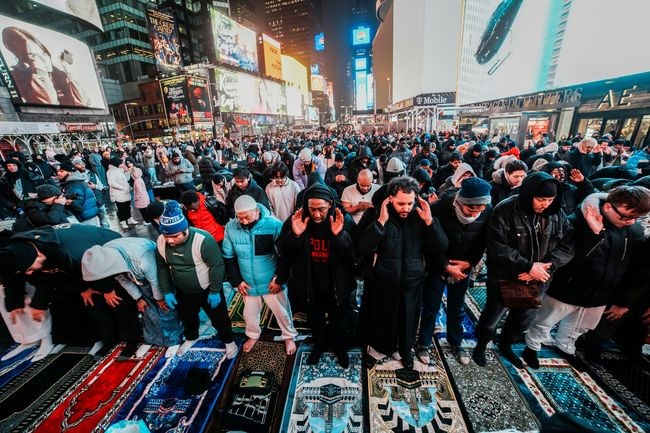
An Islamic society is one that is continuously engaged in the process of Islamization, and the mosque serves as one of its primary pillars. The mosque functions as a place for worship, personal development, the cultivation of future leaders, the refinement of Islamic values, and education. Many ideas and concepts have originated and been disseminated from the mosque, exerting a significant influence on the betterment of society.
The mosque has held a vital role from the past to the present day. Beyond serving as a venue for congregational prayer, the mosque also hosts a wide array of social activities that are consistent with Islamic law (Sharia). The mosque has proven to be a key support in the process of bringing Islamic principles into human life. The functions and roles of the mosque in shaping and developing an Islamic society include serving as:
1. A place of worship.
2. A place for the pursuit of knowledge.
3. A place for the development of the congregation.
4. A center for da’wah (Islamic outreach) and Islamic culture.
5. A center for the cultivation of future leaders (caderisation).
6. A foundation for the revival of Islam.
AWAKENING TOWARDS AN ISLAMIC SOCIETY
Muslims have proclaimed the 15th century Hijriyah as the century of Islamic revival. Formally, Islamic revival was launched by a number of Islamic countries at the First Islamic Summit (KTT) in 1969 in Rabbat, Morocco, towards the end of the 14th century. The summit decided to celebrate the beginning of the 15th Hijriyah century as the “Century of Islamic Revival”. Islamic revival means that Islam and its people can be victorious again as they have achieved in the past.
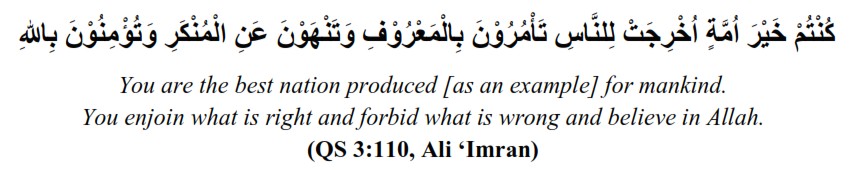
The Islamic Awakening aims to create a modern Islamic society that is able to make a positive contribution to human life and civilization. With the realization of the Islamic Society, God willing, Muslims can live in an Islamic atmosphere and bring grace to the universe. Thus, the title of the best ummah (khairu ummah) that was achieved by the first generation of Islam can be borne again by Muslims in this modern era (QS 3:110, Ali ‘Imran).
The Islamic resurgence is not a utopia. This phenomenon is evident in the enthusiasm among Muslims to return to Islam—manifested through the emergence of international Islamic organizations; national and international Islamic conferences; the rise of Islamic political parties that have garnered broad support in various countries; the adoption of distinct Islamic symbols, such as the hijab and Islamic banking; the increasing vibrancy of mosques through diverse activities; and a growing religious consciousness among the Muslim middle class, among other developments. However, according to ASM Romli, this Islamic resurgence remains merely a phenomenon rather than a fully realized reality. Therefore, now is the time for us to contribute toward the Islamic resurgence that we collectively aspire to achieve.
_________________________
BIBLIOGRAPHY
Abul A’la Maududi: “Foundations of Islam,” 1st Edition, Pustaka, Bandung, 1984.
Ali Shariati: “The Ideology of Intellectuals,” 2nd Printing, Mizan, Bandung, 1985.
Dr. Abdul Hamid Al-Ghazali: “Pillars of the Ummah’s Revival,” 2nd Printing, Al I’tishom Cahaya Umat, Jakarta, 2001.
Dr. Yusuf Al-Qaradawi: “Guidelines for Islamic Ideology,” 2nd Edition, Gema Risalah Press, Bandung, 1988.
Jakarta, 2000.
Endang Saefuddin Anshari, MA: “Islamic Perspectives (Core Thoughts on Islam and Its Community),” 2nd Edition, CV Rajawali, Jakarta, 1991.
Ir. Siswanto: “Guide to Managing Mosque Congregational Associations,” Pustaka Amani, Jakarta, 2002.
Ir. Siswanto: “Practical Guide for Mosque Youth Organizations,” Pustaka Al-Kautsar, Jakarta, 2005.
Sayyid Qutb: “Islamic Society,” 3rd Edition, PT. Al Ma’arif, Bandung, 1983.
Ziauddin Sardar: “Engineering the Future of Muslim Civilization,” 1st Edition, Mizan, Bandung, 1986.